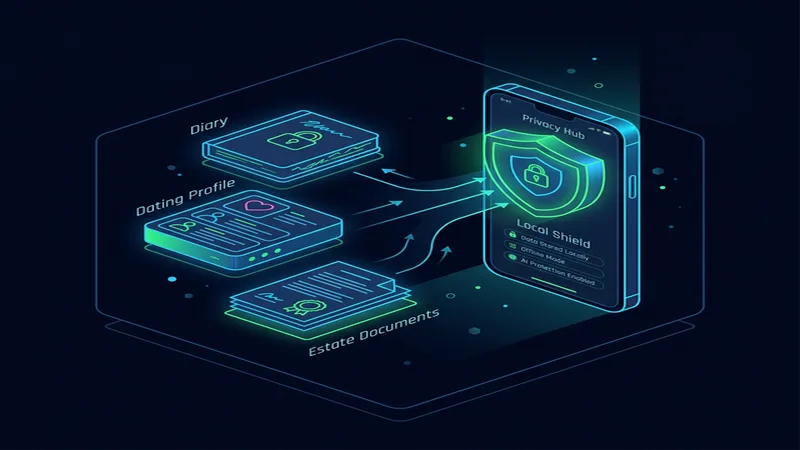
Writing & Communication
Digital Life & Planning
of consumers are concerned about AI platforms using their personal data
— Pew Research AI Attitudes Survey 2024
AI writing assistants are extraordinary tools for personal productivity — journaling, email drafting, estate planning, and life admin all benefit from AI support. But every prompt sent to a commercial AI provider is processed on external servers that may retain, review, or use that data for model training. secure AI email drafting is a common entry point: most people compose private emails in AI tools without realizing the recipient's name and contact details are being transmitted.
Understanding what PII redaction means helps individuals make informed choices about their AI tool usage. The practical alternative to platform settings and opt-outs is local tokenization — explained in our comparison of local scrubbing vs temporary chat.
Why Zero-Trust Beats Every Alternative
How PrivacyScrubber compares to common approaches in Personal workflows.
| Approach | PII sent to AI? | Reversible? | Compliance-safe? |
|---|---|---|---|
| Direct AI journaling | ✅ yes | ❌ no | n/a |
| Vague/generic prompts | partial | ❌ no | n/a |
| PrivacyScrubber ZTDS | ❌ never | ✅ yes | ✅ yes |
Try PrivacyScrubber Free
No account. No install. Works fully offline. Your Personal data never leaves your browser.
How to Use AI Safely in 3 Steps
The zero-trust workflow for this field — verified by airplane mode test.
Type or paste your personal text
Journal entries, email drafts, or planning documents — paste into PrivacyScrubber. Names, addresses, phone numbers, and personal identifiers are replaced with tokens in your browser.
Use AI for writing assistance on scrubbed text
The AI helps with tone, structure, grammar, and content without seeing your real name, your recipient's details, or any identifiable location information.
Restore and send
Paste the improved draft back into PrivacyScrubber to replace tokens with real names and details before copying to your email client or document. Nothing left a trained AI's context window.
Frequently Asked Questions
Common questions about AI data privacy in this field, answered.
Can AI assistants use my journal entries for training?
Most commercial AI providers can use conversation data for model improvement unless you opt out — and opt-out typically requires an account, specific settings, and ongoing management. Local scrubbing means your real personal content never reaches their servers to begin with.
Is it safe to write about real people in AI prompts?
No — especially for sensitive situations. Names of family members, employers, health information, and personal relationships can be stored in AI provider logs. Tokenize real names before any AI writing session.
What personal data should I never put into AI tools?
Real full names linked to sensitive situations, home addresses, phone numbers, financial details, health information, relationship details, passwords, or any information you would not want to appear in a data breach.
Does PrivacyScrubber work without an internet connection?
Yes. Once the page loads, enable Airplane Mode and the full scrub-and-restore cycle works without any network connection. This is verifiable in Chrome DevTools — zero outbound requests during processing.
Key Terms in Personal AI Privacy
Definitions that matter for understanding PII risk in personal workflows.
- Data Sovereignty
- The principle that your personal data belongs to you and should not leave your device without explicit, informed consent. PrivacyScrubber's local processing enforces data sovereignty by design.
- Token Mapping
- The 1:1 relationship between a placeholder token ([NAME_1]) and the original value stored only in your browser's session memory.
- AI Training Opt-Out
- Most AI providers allow users to opt out of having their data used for model training — but this requires account creation and careful settings management. Local scrubbing sidesteps this entirely.