Clinical & Research Workflows
Specialized & Mental Health Care
projected global healthcare AI market by 2026
— Statista Healthcare AI Report 2024
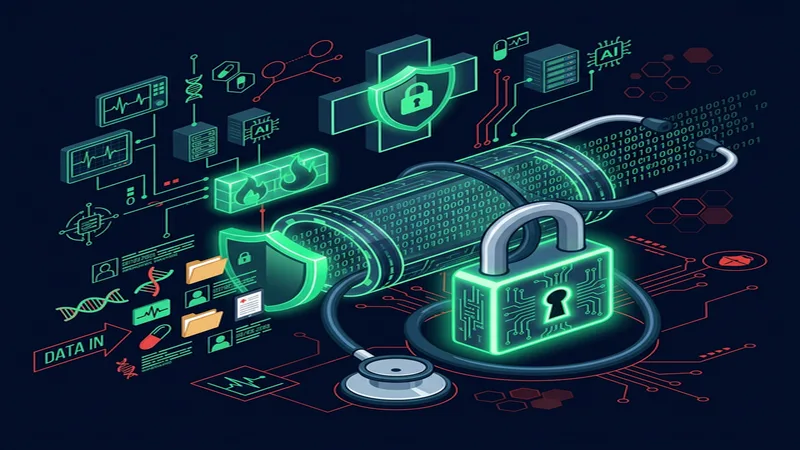
Healthcare is the highest-stakes environment for AI data privacy. HIPAA's Safe Harbor method requires removal of 18 specific identifiers before health data can be considered de-identified. Any AI tool that receives protected health information (PHI) without a Business Associate Agreement (BAA) is a HIPAA violation — and most commercial AI providers do not offer a BAA on their consumer plans. The safest workflow: medical research data safety must be anonymized locally before any LLM session begins.
The technical standard is clear. Understanding PII de-identification standards is the starting point for any clinical AI implementation. For research applications, the requirements extend to IRB protocols and 21 CFR Part 11 — areas covered in depth in our guide to clinical trial data anonymization.
Why Zero-Trust Beats Every Alternative
How PrivacyScrubber compares to common approaches in Medical workflows.
| Approach | PII sent to AI? | Reversible? | Compliance-safe? |
|---|---|---|---|
| Raw clinical notes into AI | ✅ yes | ❌ no | ❌ no |
| Manual de-ID (slow, error-prone) | partial | ❌ no | partial |
| PrivacyScrubber ZTDS | ❌ never | ✅ yes | ✅ yes |
Try PrivacyScrubber Free
No account. No install. Works fully offline. Your Medical data never leaves your browser.
How to Use AI Safely in 3 Steps
The zero-trust workflow for this field — verified by airplane mode test.
Paste clinical notes or EHR extract
Copy the clinical text into PrivacyScrubber. Patient names, DOBs, MRNs, diagnoses linked to individuals, and insurance IDs are tokenized locally in milliseconds.
Run AI analysis on de-identified text
The scrubbed text satisfies HIPAA Safe Harbor — no BAA required. Use AI for coding suggestions, summarization, or research analysis without compliance risk.
Restore for clinical documentation
Paste the AI-enhanced output back into PrivacyScrubber to reinsert patient identifiers for the final clinical record — all processed in your browser.
Frequently Asked Questions
Common questions about AI data privacy in this field, answered.
Do I need a BAA with OpenAI or Anthropic to use their AI?
To use commercial AI with PHI, yes — you need a BAA. Most consumer plans do not include one. Using PrivacyScrubber to de-identify data before the prompt means the AI never receives PHI, eliminating the BAA requirement entirely.
What are HIPAA's 18 Safe Harbor identifiers?
Names, geographic subdivisions, dates (except year), phone numbers, fax numbers, email addresses, SSNs, medical record numbers, health plan numbers, account numbers, certificate/license numbers, vehicle identifiers, device identifiers, URLs, IP addresses, biometric identifiers, full-face photographs, and any other unique identifier.
Can therapists use AI to help write clinical notes?
Yes, but only if patient identifiers are removed before the AI session. Therapy notes are among the most sensitive PHI categories. Local tokenization before AI drafting is the only HIPAA-compliant workflow for mental health providers.
Is telemedicine AI covered by HIPAA?
Yes. Any AI tool that processes patient data in a telemedicine context is subject to HIPAA if used by a covered entity or business associate. Virtual care platforms should implement client-side anonymization before any AI call.
Key Terms in Medical AI Privacy
Definitions that matter for understanding PII risk in medical workflows.
- PHI (Protected Health Information)
- Any health information that can be linked to an individual — names, dates, locations, diagnoses, insurance IDs. HIPAA prohibits its disclosure without authorization.
- HIPAA Safe Harbor Method
- De-identification standard requiring removal of 18 specific identifiers. PrivacyScrubber's engine targets all 18 categories in a single local pass.
- BAA (Business Associate Agreement)
- Contract required when a vendor handles PHI on behalf of a covered entity. Using a local scrubber before any AI call eliminates the need for a BAA with the AI provider.
- De-identification
- The process of removing or masking identifiers so that data cannot reasonably be re-linked to an individual. Differs from pseudonymization in that re-identification is not intended.
- Minimum Necessary Standard
- HIPAA rule requiring that only the minimum PHI needed for a task is used or disclosed. Tokenizing before AI analysis satisfies this principle by design.