



Home/ Guides/ Agents
5 Guides in This Category

AI Agent & RAG Pipeline Privacy Guide: Prevent PII Leaks at Every Stage

Secure multi-step AI agent workflows, RAG vector stores, and LLM fine-tuning pipelines. Scrub PII before it enters any autonomous system.

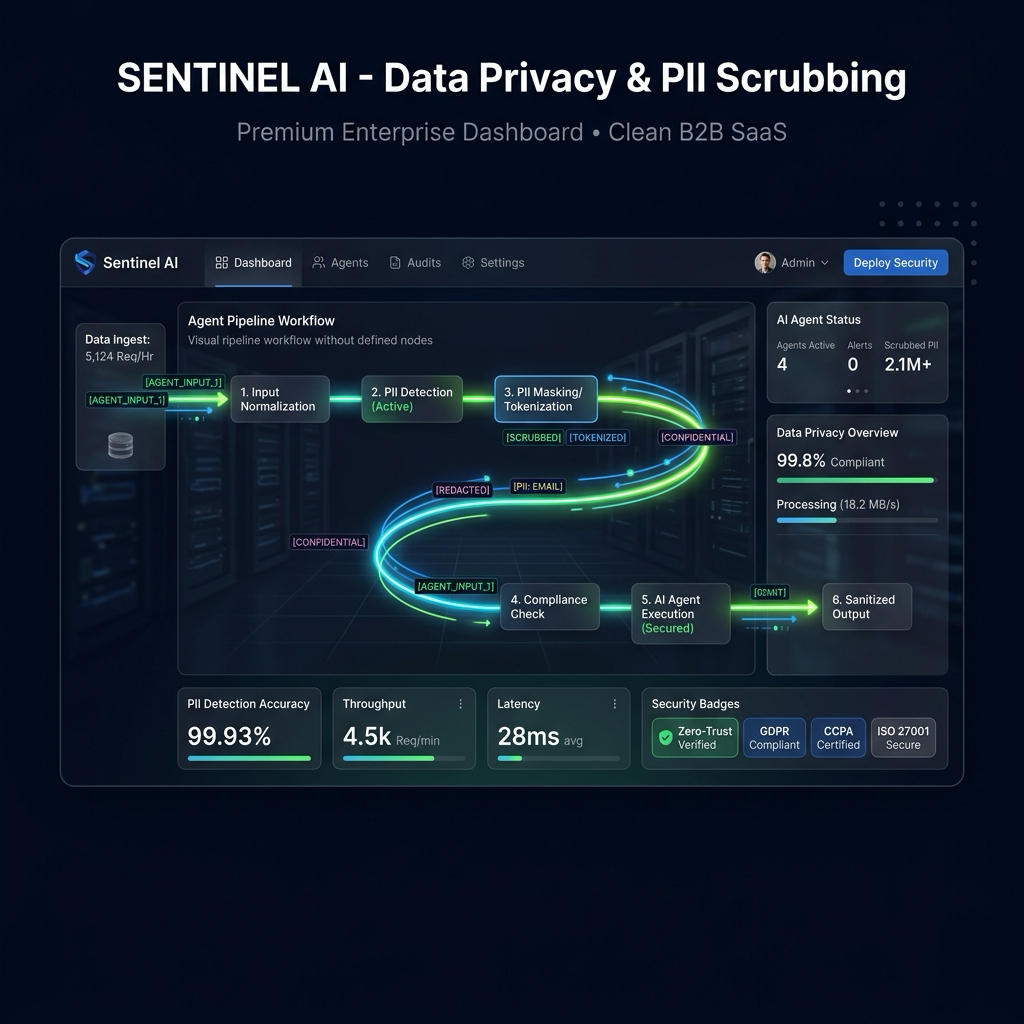
AI agents secured by privacy shields in an encrypted multi-step data pipeline — AI Agent & RAG Pipeline Privacy Guide: Prevent PII Leaks at Every Stage

“Multi-step agent workflows compound PII exposure risk at every hop. A single unredacted email in step 1 can propagate through a RAG index, appear in a tool call in step 3, and surface in a final response to a completely different user in step 7. Sanitize at ingestion — not at output.”

— PrivacyScrubber Security Research Team, 2026
100% Local Processing · Airplane Mode Verified · No Server Logs

Agent Safety & Memory

RAG, Pipelines & Fine-Tuning

25%

of enterprise workflows projected to involve agentic AI by 2027

— Forrester AI Predictions 2025

Multi-step AI agent workflows compound PII exposure at every transition: a document ingested in step one can propagate to a RAG index in step three, surface in a tool call in step five, and appear in a response to a completely different user in step seven. RAG vector store privacy is the highest-risk ingestion vector — any PII embedded in documents before vectorization is effectively permanent in the index, since embedding deletion is complex and unreliable across most vector databases.

The engineering discipline for safe agentic AI starts with sanitizing server logs for AI at every boundary where data crosses from a trusted to an untrusted system. The foundational threat model is explained in our guide to prompt injection and PII risks.

Why Zero-Trust Beats Every Alternative

How PrivacyScrubber compares to common approaches in Agents workflows.

Approach PII sent to AI? Reversible? Compliance-safe?
Raw docs into RAG index ✅ yes ❌ no ❌ no
Post-generation output filtering ✅ yes ❌ no partial
PrivacyScrubber ZTDS at ingestion ❌ never ✅ yes ✅ yes

Try PrivacyScrubber Free

No account. No install. Works fully offline. Your Agents data never leaves your browser.

How to Use AI Safely in 3 Steps

The zero-trust workflow for this field — verified by airplane mode test.

1

Scrub documents before RAG indexing

Before embedding any document into a vector store, pass it through a local PII scrubber. Tokenized documents can be indexed safely — the AI retrieves context without retrieving identifiable data.

2

Sanitize all agent inputs at ingestion

At every boundary where external data enters an agentic pipeline — email parsing, web scraping, form submissions — apply local tokenization before the data is passed to the agent's context window.

3

Verify non-persistence of session maps

Ensure that token-to-value mappings used in the agent pipeline are scoped to the session and never written to persistent storage, logs, or external databases. Re-identification must stay under your control.

Frequently Asked Questions

Common questions about AI data privacy in this field, answered.

Why is RAG a high PII risk compared to simple chat?

In a simple chat session, PII in the prompt is seen only by that session. In a RAG system, PII in an indexed document can surface in responses to any future user who triggers a relevant retrieval. Pre-ingestion scrubbing is the only way to prevent this propagation.

Can AI agents retain PII across sessions?

Agent memory systems that persist context across sessions accumulate PII over time. Session-scoped tokenization — where the mapping is destroyed after each session — prevents this accumulation. PrivacyScrubber's session map is always ephemeral by design.

What is a prompt injection attack in an agentic context?

A prompt injection attack embeds adversarial instructions in data that an agent will process — causing the agent to take unintended actions, leak context, or exfiltrate data. Scrubbing PII before agent ingestion reduces the blast radius if an injection occurs.

How do we handle PII in LLM fine-tuning datasets?

Fine-tuning a model on data containing PII causes the model to memorize it. Use PrivacyScrubber to scrub the training dataset before it is submitted for fine-tuning. Post-training data removal (unlearning) is technically immature — prevention at ingestion is the only reliable control.

Key Terms in Agents AI Privacy

Definitions that matter for understanding PII risk in agents workflows.

RAG (Retrieval-Augmented Generation)
Architecture where an LLM retrieves relevant documents from a vector database before generating a response. Documents containing PII in the index can be surfaced to any user.
Vector Store PII
Personal data that has been embedded and indexed in a vector database. Once embedded, PII is difficult to fully remove — making pre-ingestion redaction critical.
Agentic AI
LLM-powered systems that autonomously take actions (web search, code execution, API calls) over multiple steps. Each action boundary is a potential PII leakage point.
Memory Persistence
AI agent systems that store previous context across sessions can accumulate PII over time. Session-scoped, ephemeral token maps prevent this accumulation.
Fine-Tuning PII Risk
Training a model on data containing PII causes the model to memorize and potentially reproduce that PII in responses — even to unrelated queries.
View All 81 Guides →