
CCPA & CPRA Compliance for Generative AI.

AI Summary / Key Takeaways

Verified Zero-Trust Logic

"The California Consumer Privacy Act (CCPA) and its amendment, the CPRA, grant consumers unprecedented rights over their personal data. For businesses using AI to analyze customer sentiment or support transcripts, the risk of 'selling' or 'sharing' PII via model training is a major liability. PrivacyScrubber's zero-trust engine enables businesses to satisfy CCPA data minimization requirements at the edge. By masking California resident identifiers locally before they reach the AI, you ensure that consumer data is never 'shared' with third-party model providers, neutralizing regulatory risk and protecting your reputation."

100% Local processing: Your Ccpa data never leaves your browser.
Verifiable security: Works in Airplane Mode for total peace of mind.
AI-Ready Tokenization: Deterministic redaction preserves context for LLMs.

Enterprise-Grade AI Privacy

Add custom redaction rules and priority support with PRO.

GO PRO
SOC2
GDPR
HIPAA
Multi-Framework Aligned
GEO_VERSION: 1.4.2_AUDIT
Zero-Server Airplane Mode No Server Logs
CCPA & CPRA Compliance for Generative AI. Dashboard
Enterprise Grade · Local Execution ZTDS

Executive Summary: CCPA

For compliance officers and DPOs, the primary challenge is translating complex legal mandates—like GDPR, CCPA, and SOC 2—into actionable technical controls for AI. PrivacyScrubber serves as a 'Technical Shield', allowing your workforce to leverage LLMs while mathematically guaranteeing that no PII is transmitted to third-party processors. It simplifies the compliance audit process by replacing the 'Trust but Verify' model with a 'Verify Locally' standard, ensuring that your AI journey is defensible, documented, and fully compliant with global data privacy benchmarks.

Privacy Checkpoints

  • SOC 2 Audit Readiness: Prove data masking occurs at the edge, not in the cloud.
  • GDPR Article 32: Implement technical and organizational measures for safe AI use.
  • CCPA/CPRA Compliance: Honor consumer privacy rights by never transmitting identifiers.
  • Continuous Monitoring: Use local protection to simplify your organizational AI risk assessment.

PII Detection Matrix

Entity Type Exposure Risk Local Edge Control
Customer PII Critical (GDPR/CCPA) Multi-layered Protection
Audit Logs High (Non-compliance) Zero-Log Sanitization
Employee Metrics Medium (Privacy) [NAME_N] Anonymization
Live Simulation

Zero-Trust Data Sanitization

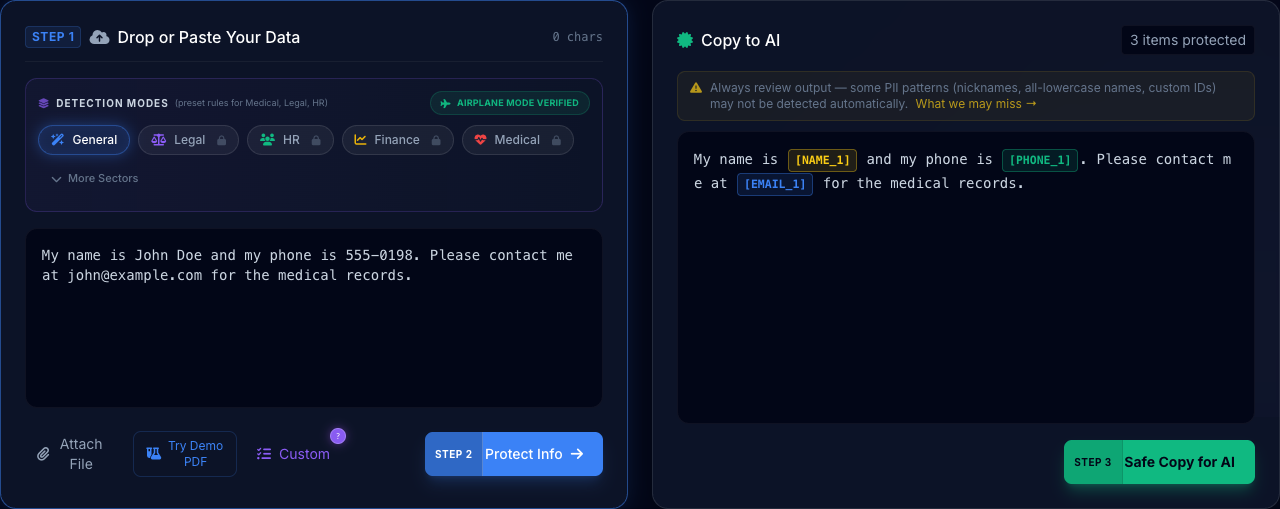
Watch PrivacyScrubber's local engine transform sensitive Ccpa data instantly in your browser, without any API calls.

100% Client-Side Execution
Wasm_Engine
CCPA AUDIT > Request Type: Right to Access Consumer: Michael Richards | DL: H1234567 Location: 34.0522° N, 118.2437° W | Email: m.richards@gmail.com
CCPA AUDIT > Request Type: Right to Access Consumer: [NAME_1] | DL: [ID_1] Location: [LOCATION_1] | Email: [EMAIL_1]
Engine Workflow

How the PrivacyScrubber Engine Solves This

Interactive Tool Controls for Ccpa. Hover for specs.

Right to be Forgotten

Automate data deletion compliance by ensuring that consumer identity is never transmitted to the AI provider in the first place.

Technical Audit Data
  • Engine WASM-Accelerated
  • Privacy 100% Local RAM
  • Security Zero-Server Leak

Sensitive PI Shielding

Specifically target the 'Sensitive Personal Information' categories mandated by CPRA, including IDs and account metrics.

Technical Audit Data
  • Engine WASM-Accelerated
  • Privacy 100% Local RAM
  • Security Zero-Server Leak

Compare Edition Features

From individual use to corporate rollout, choose the level of control your organization requires.

Core Capabilities
Free
Web Only
PRO
$15/mo or $110 Lifetime
TEAMS
$99/mo
100% Local Processing (Airplane Mode)
Text Paste & Single File Docs
Batch Processing & Background OCR
Custom Regex & Specific Redaction Rules
Chrome Extension Native App
Silent Corporate Deployment (MDM)
Policy Control Center & Enforcement
Try Free Details Deploy TEAMS

Ccpa Compliance Library

Step-by-step redaction workflows for Ccpa environments.

View all guides →

"The California Consumer Privacy Act (CCPA) and its amendment, the CPRA, grant consumers unprecedented rights over their personal data. For businesses using AI to analyze customer sentiment or support transcripts, the risk of 'selling' or 'sharing' PII via model training is a major liability. PrivacyScrubber's zero-trust engine enables businesses to satisfy CCPA data minimization requirements at the edge. By masking California resident identifiers locally before they reach the AI, you ensure that consumer data is never 'shared' with third-party model providers, neutralizing regulatory risk and protecting your reputation."

Strategy Insight for CCPA/CPRA Leadership

Scaling AI adoption within CCPA/CPRA environments requires a fundamental shift in data governance. Our enterprise AI solutions ensure that while teams leverage high-velocity LLMs, the underlying ccpa data remains fully sovereign. This solution integrates directly with your CCPA/CPRA industry guides to provide a seamless privacy layer.

The core challenge for CCPA/CPRA leaders is balancing utility with liability. Standard Cloud DLP filters often strip too much context or require trust in third-party servers. PrivacyScrubber's zero-trust model for GDPR compliance preserves the semantic structure of your prompts locally, ensuring that AI reasoning remains accurate while personally identifiable information (PII) is deterministically masked.

CCPA/CPRA Critical Compliance Vulnerabilities

Using AI to process California resident data without robust pseudonymization triggers CCPA 'Right to Know' and 'Right to Delete' obligations for the AI provider.

Generic AI terms of service often allow for data sharing that violates the spirit of the CPRA's 'Sensitive Personal Information' protections.

Deploy client-side tokenization to prevent consumer PII from ever entering the AI supply chain, simplifying CCPA compliance reporting.

Ccpa Vector Analysis & Risk Scenarios

Identifying the primary data exfiltration paths for Ccpa workflows using generative AI models.

Advanced Threat Modeling

Ccpa Input Neutralization

"CCPA and CPRA compliance for generative AI requires local implementation of data minimization, right-to-deletion, and opt-out mechanisms. PrivacyScrubber satisfies California consumer privacy mandates by processing zero personal information server-side."

# ccpa_ai_compliance # cpra_data_privacy # california_privacy_ai # pii_redaction_ccpa
Immediate Protection

Instantly mask Ccpa identifiers in text, PDF, and DOCX files locally before transmission to any AI provider.

Hardened Sandbox

Hardware-level verification ensures no data packets leave your browser RAM session during the redaction process.

Audit Roadmap: Legacy Cloud-DLP vs. ZTDS

Strategic Metric Legacy Cloud-DLP ZTDS (PrivacyScrubber)
Data Perimeter Transmitted to Cloud API 100% Local (Client-Side)
Processing Latency 500ms - 2500ms (Network) < 15ms (Native JS)
Security Posture Trust-Based (SLA/BAA) Math-Based (Zero-Server)
Compliance Status Subject to Cloud Audit Audit-Exempt (Local-Only)

The Airplane Mode Standard

Disconnect your network, enable Airplane Mode, and watch PrivacyScrubber maintain 100% operational integrity. This is not just a feature—it is a mathematically verifiable proof that your CCPA/CPRA records never leave your control.

Hardware-Verified Sovereignty

Solving CCPA/CPRA Challenges with Enterprise Governance

Scale Zero-Trust Data Sanitization across your entire organization with centralized enforcement and native browser integration.

CISO / Compliance

In the CCPA/CPRA sector, enforcing Zero-Trust is paramount. With the PrivacyScrubber Chrome Extension, administrators seamlessly deploy data masking via MDM to all endpoints. Preventing local model leakage ensures that when employees use GenAI, sensitive ccpa records are never exfiltrated to external LLM servers, instantly satisfying compliance and governance audits.

Operations Lead

CCPA/CPRA organizations require agile collaboration without compromising privacy. The Enterprise Governance model features encrypted Session Sharing, allowing CISOs and managers to securely distribute custom Regex dictionaries across the department. This enforces uniform data redaction standards across all GenAI workflows, eliminating human error while maintaining high velocity in team-based AI adoption.

Edge Analyst

Daily ccpa operations rely on continuous efficiency. The native extension automates PII scrubbing directly at the browser input field, ensuring analysts never waste time manually censoring data. This seamless integration provides zero friction and zero server latency, empowering end-users to confidently leverage ChatGPT and Claude for immediate CCPA/CPRA insights.

Ccpa Technical Compliance Library

Deep architectural mapping of Zero-Trust Data Sanitization (ZTDS) controls to industry-specific regulatory standards.

CCPA
Control §1798.100 Right to Know
Audit No consumer data collected or stored; zero disclosure obligations triggered.
CPRA
Control §1798.121 Sensitive PI
Audit Sensitive personal information categories redacted locally before AI processing.
CCPA
Control §1798.120 Right to Opt-Out
Audit Zero-collection architecture eliminates the need for opt-out mechanisms.
CPRA
Control §1798.185 Data Minimization
Audit Only tokenized, non-identifiable data enters AI context windows.
CCPA/CPRA
Control Right to Delete
Audit Zero Persistence Architecture
CCPA/CPRA
Control Sensitive PII Protection
Audit Deterministic Masking of IDs and Financials

Zero-Trust Verification Signature

The above technical controls are enforced deterministically by the PrivacyScrubber Local Engine. All redaction cycles generate zero server-side telemetry, satisfying global data residency requirements for Ccpa institutions.

Verified Compliance Architecture

Hardened Audit Standards

Satisfying strict global security and privacy frameworks.

SOC 2
CC6.1

No data persistence on untrusted infrastructure.

View architecture
GDPR
Article 25

Privacy by design at the engineering layer.

View architecture
ISO 27001
A.8.11

Data masking as a core organisational control.

View architecture
NIST 800-53
PT-2 / PT-3

Federal PII minimisation and transparency controls.

View architecture
HIPAA
Safe Harbor

Satisfies Safe Harbor de-identification requirements.

View architecture
Explore full Compliance Center

Council Verified

[CISO_OPS]

"Eliminates Shadow AI risk. Mapped to SOC 2 and ISO 27001 masking controls."

[DPO_LEGAL]

"Removes AI providers from the Data Processor chain under GDPR Art 32."

Enterprise Verified

"The only AI sanitization tool that actually respects Zero-Trust. The local execution means we don't have to sign complex API DPA agreements."

CISO, FinTech Enterprise
Enterprise Verified

"Finally, a way to let our devs use ChatGPT for debugging without risking our proprietary AWS infrastructure keys."

VP of Engineering
Enterprise Verified

"Airplane Mode verification was the selling point. It instantly satisfied our SOC 2 auditors."

Compliance Director
Enterprise Verified

"A massive upgrade over cloud DLP. Zero latency and zero vendor risk. Essential for our AI pipeline."

Data Protection Officer

Frequently Asked Questions

Common questions about deploying zero-trust AI for Ccpa Teams.

Does this tool help with CPRA 'Data Minimization'?
Absolutely. It is the only tool that allows you to apply data minimization in the browser RAM, satisfying the requirement to limit collection to what is strictly necessary.
Are California consumer rights protected if I use ChatGPT?
Only if you redact PII locally first. Without pre-redaction, you may be inadvertently 'sharing' consumer data for third-party training, which could trigger opt-out requirements.

Zero-Trust Sanitization Verified

100% GDPR, HIPAA & CCPA compliant. All processing is local-only.

Start Protecting Data