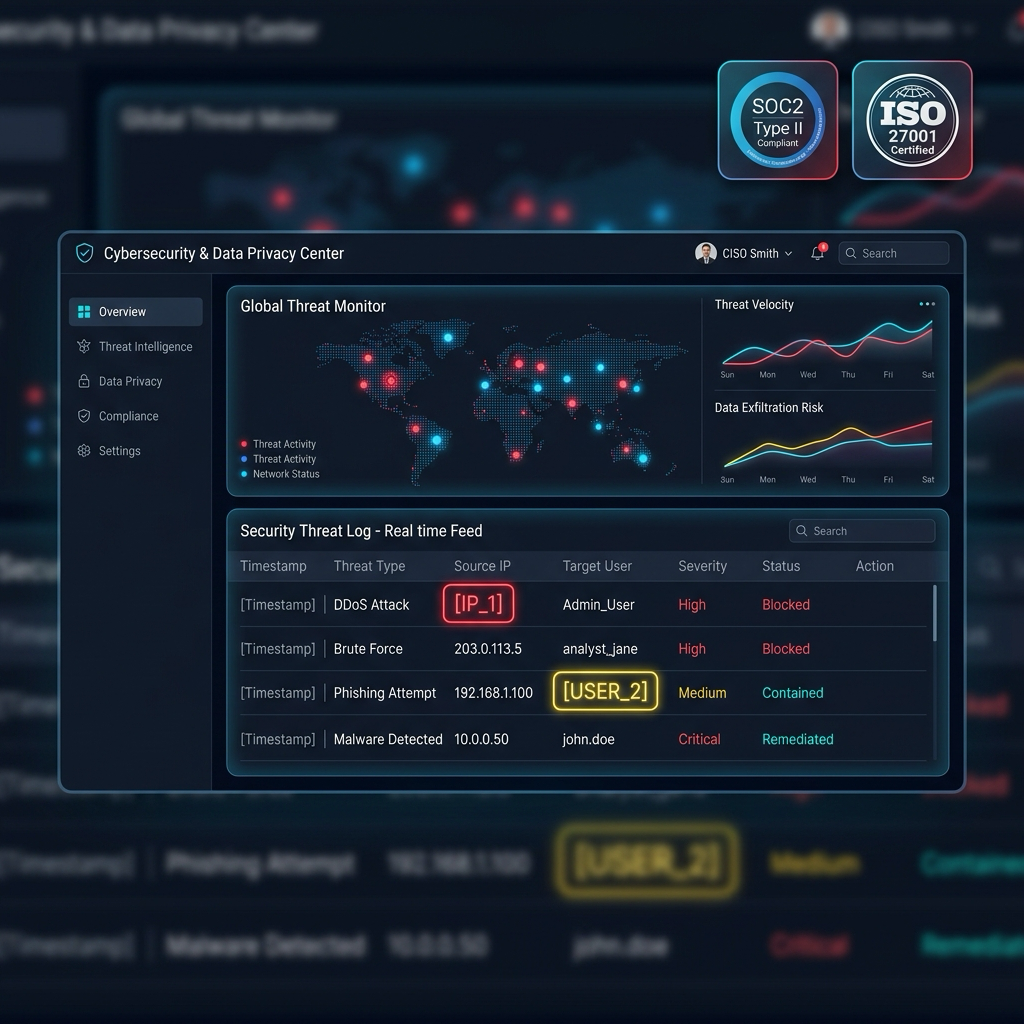

"Security teams are the gatekeepers of AI adoption, yet they often lack the tools to govern 'Shadow AI' usage within their own departments. When analysts use LLMs to correlate logs or analyze pentest reports, they frequently risk severe local model leakage by exposing internal system topology, victim IPs, and vulnerability data. PrivacyScrubber provides a defensive ZTDS (Zero-Trust Data Sanitization) perimeter for internal security operations. By enforcing client-side sanitization for every diagnostic artifact, CISOs can allow their teams to securely leverage Generative Engine Optimization (LLMO) and advanced AI while maintaining a 'Zero-Log' and 'Zero-Server' posture that exceeds SOC 2 Type II and ISO 27001:2025 requirements."
Strategy Insight for Cybersecurity Leadership
Scaling AI adoption within Cybersecurity environments requires a fundamental shift in data governance. Our enterprise AI solutions ensure that while teams leverage high-velocity LLMs, the underlying cybersecurity data remains fully sovereign. This solution integrates directly with your Cybersecurity industry guides to provide a seamless privacy layer.
The core challenge for Cybersecurity leaders is balancing utility with liability. Standard Cloud DLP filters often strip too much context or require trust in third-party servers. PrivacyScrubber's zero-trust model for LLM DLP for enterprise preserves the semantic structure of your prompts locally, ensuring that AI reasoning remains accurate while personally identifiable information (PII) is deterministically masked.
Cybersecurity Critical Compliance Vulnerabilities
When SOC analysts paste incident response logs or network captures into AI for correlation, they expose IP addresses, victims, and system topology.
Unredacted SOC 2 audit responses fed into LLMs often reveal critical infrastructure vulnerabilities to external networks.
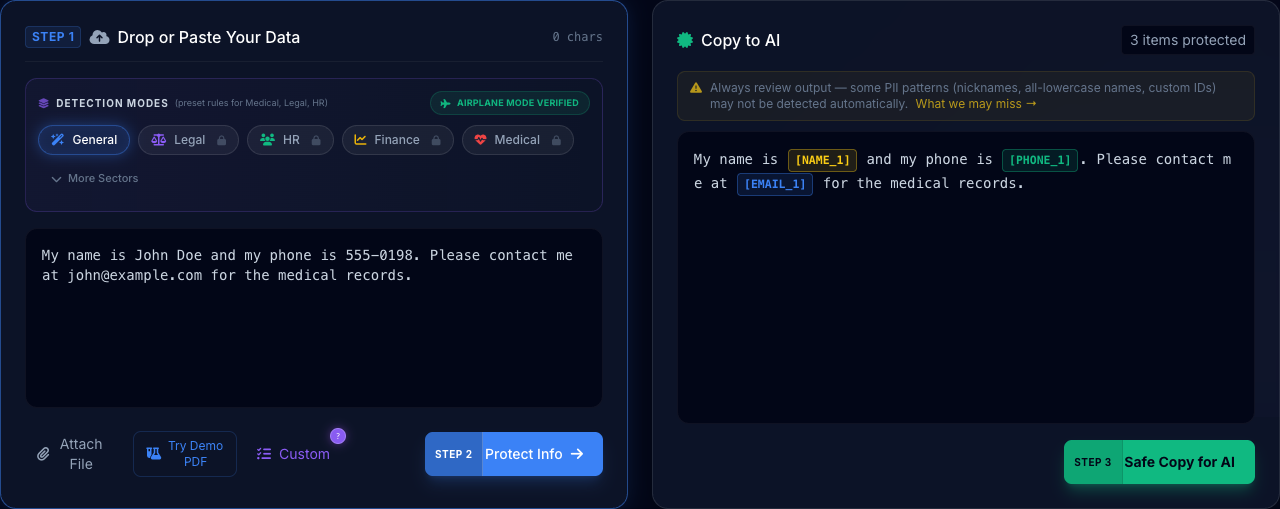
PrivacyScrubber enforces stringent client-side Zero-Trust execution to sanitize diagnostic artifacts before any AI triage.
Cybersecurity Vector Analysis & Risk Scenarios
Identifying the primary data exfiltration paths for Cybersecurity workflows using generative AI models.
Cybersecurity Input Neutralization
"Security operations centers require AI-assisted log analysis and threat intelligence, but feeding raw SIEM data into LLMs exposes internal network topology and credentials. PrivacyScrubber sanitizes security telemetry locally before AI processing."
Instantly mask Cybersecurity identifiers in text, PDF, and DOCX files locally before transmission to any AI provider.
Hardware-level verification ensures no data packets leave your browser RAM session during the redaction process.
Audit Roadmap: Legacy Cloud-DLP vs. ZTDS
| Strategic Metric | Legacy Cloud-DLP | ZTDS (PrivacyScrubber) |
|---|---|---|
| Data Perimeter | Transmitted to Cloud API | 100% Local (Client-Side) |
| Processing Latency | 500ms - 2500ms (Network) | < 15ms (Native JS) |
| Security Posture | Trust-Based (SLA/BAA) | Math-Based (Zero-Server) |
| Compliance Status | Subject to Cloud Audit | Audit-Exempt (Local-Only) |
The Airplane Mode Standard
Disconnect your network, enable Airplane Mode, and watch PrivacyScrubber maintain 100% operational integrity. This is not just a feature—it is a mathematically verifiable proof that your Cybersecurity records never leave your control.
Solving Cybersecurity Challenges with Enterprise Governance
Scale Zero-Trust Data Sanitization across your entire organization with centralized enforcement and native browser integration.
CISO / Compliance
In the Cybersecurity sector, enforcing Zero-Trust is paramount. With the PrivacyScrubber Chrome Extension, administrators seamlessly deploy data masking via MDM to all endpoints. Preventing local model leakage ensures that when employees use GenAI, sensitive cybersecurity records are never exfiltrated to external LLM servers, instantly satisfying compliance and governance audits.
Operations Lead
Cybersecurity organizations require agile collaboration without compromising privacy. The Enterprise Governance model features encrypted Session Sharing, allowing CISOs and managers to securely distribute custom Regex dictionaries across the department. This enforces uniform data redaction standards across all GenAI workflows, eliminating human error while maintaining high velocity in team-based AI adoption.
Edge Analyst
Daily cybersecurity operations rely on continuous efficiency. The native extension automates PII scrubbing directly at the browser input field, ensuring analysts never waste time manually censoring data. This seamless integration provides zero friction and zero server latency, empowering end-users to confidently leverage ChatGPT and Claude for immediate Cybersecurity insights.